

Last updated: October 12, 2026
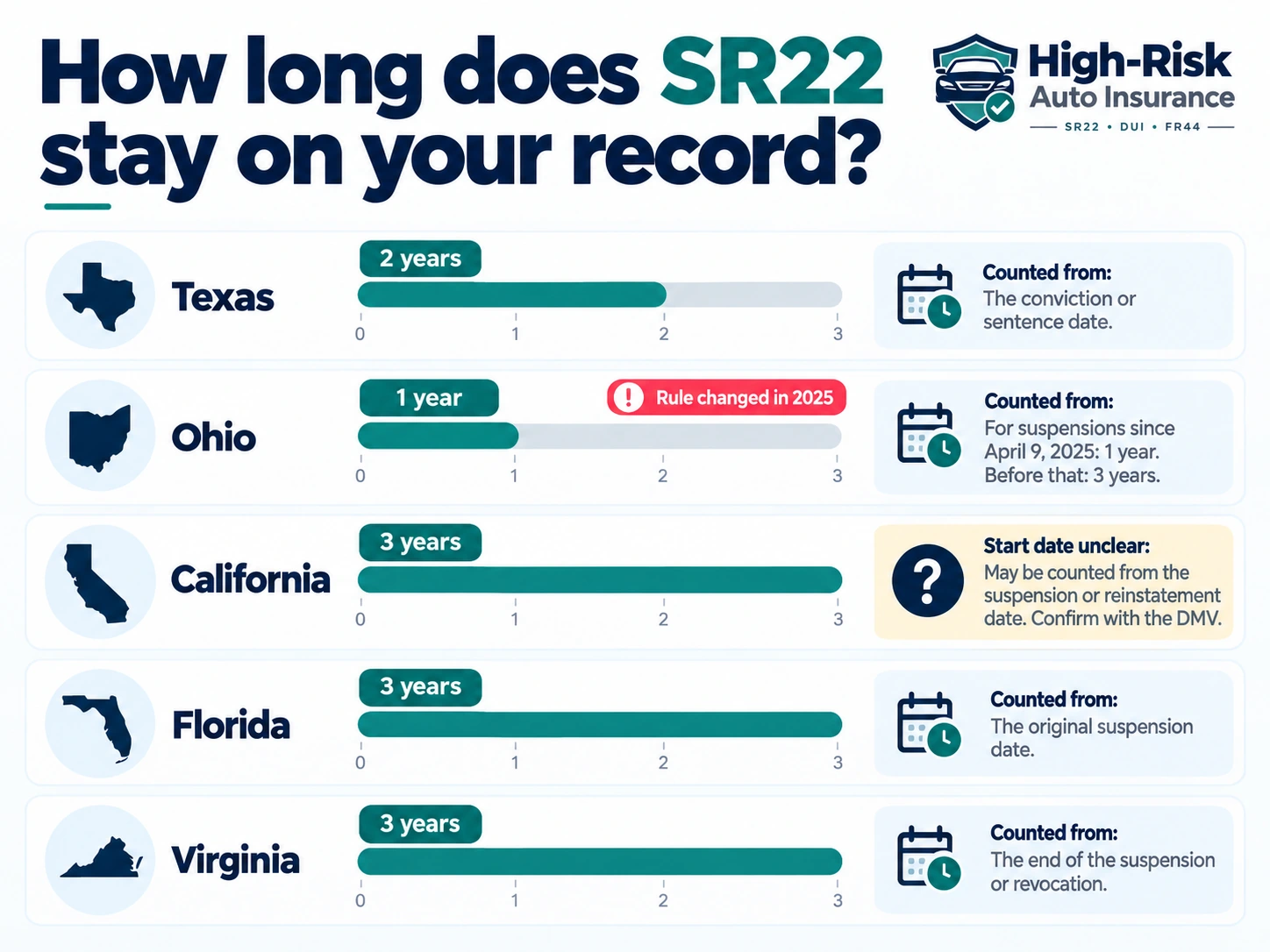
How long does SR22 stay on your record? Almost every page answers “three years,” and for a real share of drivers that answer is wrong. Texas closes the requirement in two years. Ohio cut its own rule to one year in April 2025, after holding at three to five years for over a decade. California, Florida, Virginia and Georgia use three. Knowing the length is one step, and ending the filing cleanly is another, which we cover in how to get rid of SR22.
Your real timeline depends on which state suspended your license and why. It doesn’t depend on a number copied from a competitor’s blog.
How Long Does SR22 Stay on Your Record? Duration by State
No federal SR22 law exists. Each state’s DMV or its equivalent (a Bureau of Motor Vehicles, Department of Public Safety or Department of Transportation) sets its own filing period. That period ties to your underlying suspension, not to the SR22 form itself. A DUI conviction, a string of moving violations and an uninsured at-fault accident can each trigger a different length, even inside one state’s statute book.
Below are the states we checked against official sources. We don’t list all fifty. Presenting an unverified guess as fact would do you less good than telling you plainly where our research stopped.
| State | Period | Counted from |
|---|---|---|
| Texas | Two years | Date of conviction or judgment |
| Ohio | One year since April 9, 2025 (previously three, or five with a prior violation within five years) | Confirm with the BMV, the wording on the transition is not perfectly clear |
| California | Three years | Unclear: suspension date or reinstatement date. Confirm with the DMV Insurance Unit |
| Florida | Three years | Original suspension date per the insurer manual. The DUI FAQ words the FR-44 term as three years from reinstatement |
| Virginia | Three years | End of the suspension or revocation, or the date you satisfy a judgment |
| Georgia | Three years | Conviction date for a second or later no-insurance conviction. Premium prepaid every six months |
| Minnesota | One calendar year | State certificate, not called an SR22 |
Texas: Two Years, Counted From the Conviction Date
The Texas Department of Public Safety requires SR22 coverage for two years. The clock starts on the date of conviction or judgment, not on the date you file the certificate or get your license back.
That distinction catches people off guard. Say a driver is convicted in March but doesn’t get reinstated until June, a common gap once court processing and paperwork add up. Those three months still count against the two years. Texas doesn’t add them back on top.
Let the policy lapse anywhere in that window and DPS doesn’t extend a grace period. It re-suspends the license, requires a new SR22 filing from scratch, and adds a $100 reinstatement fee on top of whatever your insurer already billed. The requirement ends on its own after two years of uninterrupted coverage, and you don’t need to file anything to end it.
Ohio: One Year, Since a Rule Change Most Articles Missed
Ohio used to run one of the longer SR22 holds in the country. A first offense meant three years, and a prior qualifying violation within five years meant five. On April 9, 2025, the Ohio Bureau of Motor Vehicles cut both figures to one year. The Ohio BMV non-compliance page describes the change, and its wording on the transition isn’t perfectly clear, so confirm your case with the BMV.
We flag this by date on purpose. A meaningful amount of content that still ranks for Ohio SR22 queries predates April 2025 and quotes the old figures as current fact. If an “Ohio SR22 duration” article carries a 2023 or 2024 byline, or no update date, you probably face a rule that no longer applies. That gap is the difference between one year of high-risk premiums and three.
California: Three Years, but Confirm When It Starts
California keeps the three-year reputation, and here it holds. The state’s DUI fact sheets say you must maintain the SR 22 for three years, and the California Driver Handbook describes the same three-year maintenance period after a financial-responsibility suspension.
What the DMV pages don’t spell out is whether the window starts on the suspension date or the reinstatement date, and the fact sheets can read either way. Call the DMV’s Insurance Unit, or ask your insurer which filing date it submitted. That date legally controls your requirement, and it beats our reading of any handbook.
Florida, Virginia and Georgia: Three Years With Different Start Dates
Florida’s procedures manual for insurers says to maintain the SR22 or FR-44 for three years from the original suspension date. Its DUI FAQ words the FR-44 term as three years from reinstatement. Both come from the state, so quote the one that matches your paperwork.
Virginia counts three years from the end of your suspension or revocation, or from the date you satisfy a judgment. Its DMV penalties page says the insurer reports a lapse during that period. Georgia requires three years from the conviction date for a second or later no-insurance conviction, and it wants the premium prepaid every six months.
Minnesota sits in its own category. It doesn’t use the SR22 name. Its state certificate must stay in place for one calendar year.
How Long Does SR22 Stay on Your Record Compared With the Conviction?
The SR22 doesn’t show up as a separate mark. It’s a certificate your insurer files with the state, not a violation or a set of points on your license, and it doesn’t extend your driving record on its own.
What stays on your record, often far longer than the SR22 requirement, is the underlying conviction: a DUI, reckless driving or repeated at-fault violations. Retention periods for the conviction are set separately and vary by state. California’s DMV keeps a DUI on your record for 10 years. Don’t assume the conviction disappears when your SR22 period ends. Insurers and employers can still see it. Those are two different clocks, and this article answers only one of them.
When Does the Clock Actually Start Ticking?
Most drivers lose track of their timeline here, because three candidate start dates rarely land on the same day.
| Start date | What it means |
|---|---|
| Conviction or judgment date | When the court found you guilty or you entered a plea. Texas counts from here |
| Suspension date | When the state actually pulled your driving privileges. It can trail the conviction by several weeks |
| Reinstatement date | When you got your license back and the SR22 filing went active with your insurer |
Texas states plainly that its two years run from the conviction date. Other states peg the requirement to the suspension or reinstatement date, which can shift your real end date by a month or more. The safest move in any state is to pull the suspension or reinstatement notice your DMV or BMV mailed you. That letter usually states the exact date the state counts from, and it beats any estimate a website can give you, including this one.
How Long Does SR22 Stay on Your Record After a Lapse?
Insurers must report a cancellation or a missed payment to the state the same way they reported the original filing, and no quiet grace period exists. A lapsed SR22 policy typically gets flagged within days. In Texas the consequence is documented: license re-suspension, a new SR22 filing and a $100 reinstatement fee.
Does the lapse restart your clock? Insurer and press guides say it usually does, and the pattern held in every case we reviewed. The Texas and Virginia pages we read say only that the state suspends you again and requires a new filing. Read our guide on what happens when an SR22 lapses for the full sequence.
If you’re close to your end date and tempted to switch to a cheaper policy, confirm the new one is active, with its SR22 filed, before you cancel the old one. A single missed day between policies can trigger the same reset as a full cancellation.
How Long Will SR22 Stay on Your Record If You Move?
An SR22 doesn’t transfer between states the way a license does. The state that ordered it keeps ownership of the requirement, so moving doesn’t end it. Your original state still expects proof of coverage for the period it set, and your new state may add its own rules on top.
Confirm this with both agencies before you assume your countdown carries over unchanged. We found no state that guarantees it does. Our guide on whether SR22 follows you to another state walks through three moving scenarios.
How to Confirm Your Own End Date Instead of Guessing
Skip the estimate and get the real number.
- Ask your current insurer for the exact SR22 filing date it submitted to your state. Nearly every state builds its calculation around that anchor date.
- Contact your state’s DMV, BMV or Department of Public Safety and ask which date it counts from: conviction, suspension or reinstatement.
- Keep the official notice your state mailed you when the requirement began. It states your date in writing, and you’ll want it if anyone ever disputes whether your requirement ended.
None of this takes more than a phone call. It’s the only reliable way to know your own date instead of borrowing a number that fits a different state’s statute. Before any of these clocks can start, the filing has to be in place, and How to Get SR22 Insurance covers the steps. The SR22 filing fee and reinstatement costs are a separate matter worth budgeting for.
If a DUI triggered your filing, how long a DUI affects insurance rates explains the separate insurer clock that keeps running after the SR22 ends.
The team at High Risk Auto Guide isn’t a licensed insurance agency. The information in this article is educational and based on official, verified sources as of the date noted. Confirm the details that apply to your specific case with your state’s DMV/BMV or with your own insurance company.