Last updated: October 20, 2026
SR22 insurance Texas drivers need isn’t a special policy. It’s a certificate your insurer files with the Texas Department of Public Safety (DPS) to prove you carry at least the state minimum liability coverage. DPS decides when you need it, how long you keep it and what reinstatement costs. Your insurer only files the form and reports any cancellation.
Most guides blur the legal trigger and the price. We keep them apart, because the trigger is a legal fact and the price is a market estimate. If you want the basics first, start with our explainer on what SR22 insurance is.
When SR22 Insurance Texas Requires a Filing
According to the DPS SR-22 page, the department can require a certificate in four situations. First, after a crash that leads to a suspension. Second, after a second or later conviction for driving without liability insurance. Third, when a civil judgment is filed against you. Fourth, when you place a security deposit with the department after a crash. If your filing follows a DWI, our guide to car insurance after a DUI in Texas shows how the conviction changes your rate and how the two-year requirement works.
However, the newer DPS chart (form DL-176, revised December 2024) adds a nuance. It lists a crash suspension as needing an SR-22 only if you file a security deposit. So the crash trigger is narrower than the older page suggests, and you should confirm your own case with DPS.
DWI is the trigger most drivers meet. DPS states that an SR-22 is required for both adult and minor DWI convictions. The DPS FAQ on proof of financial responsibility also names drug offenses, driving with an invalid license and multiple no-insurance convictions as examples.
One detail trips people up. Refusing or failing a breath or blood test causes an administrative license revocation (ALR) suspension. According to DL-176, an ALR suspension by itself doesn’t require an SR-22. The filing follows the DWI conviction. As a result, one arrest can produce two suspensions, and only the conviction side carries the certificate.
Texas Liability Limits: What the Certificate Must Prove
Texas requires 30/60/25 liability coverage. That means $30,000 for injury or death to one person, $60,000 for two or more people in one crash and $25,000 for property damage. The DPS page and Transportation Code chapter 601 give the same three numbers, and they have applied since 2011.
Your certificate confirms at least those limits. Buying more is allowed, and buying less isn’t. Still, the minimums are low. One serious crash can produce medical bills above $60,000. Ask each insurer for a quote at higher limits too, then compare the price gap yourself.
How Long You Need SR22 Insurance in Texas
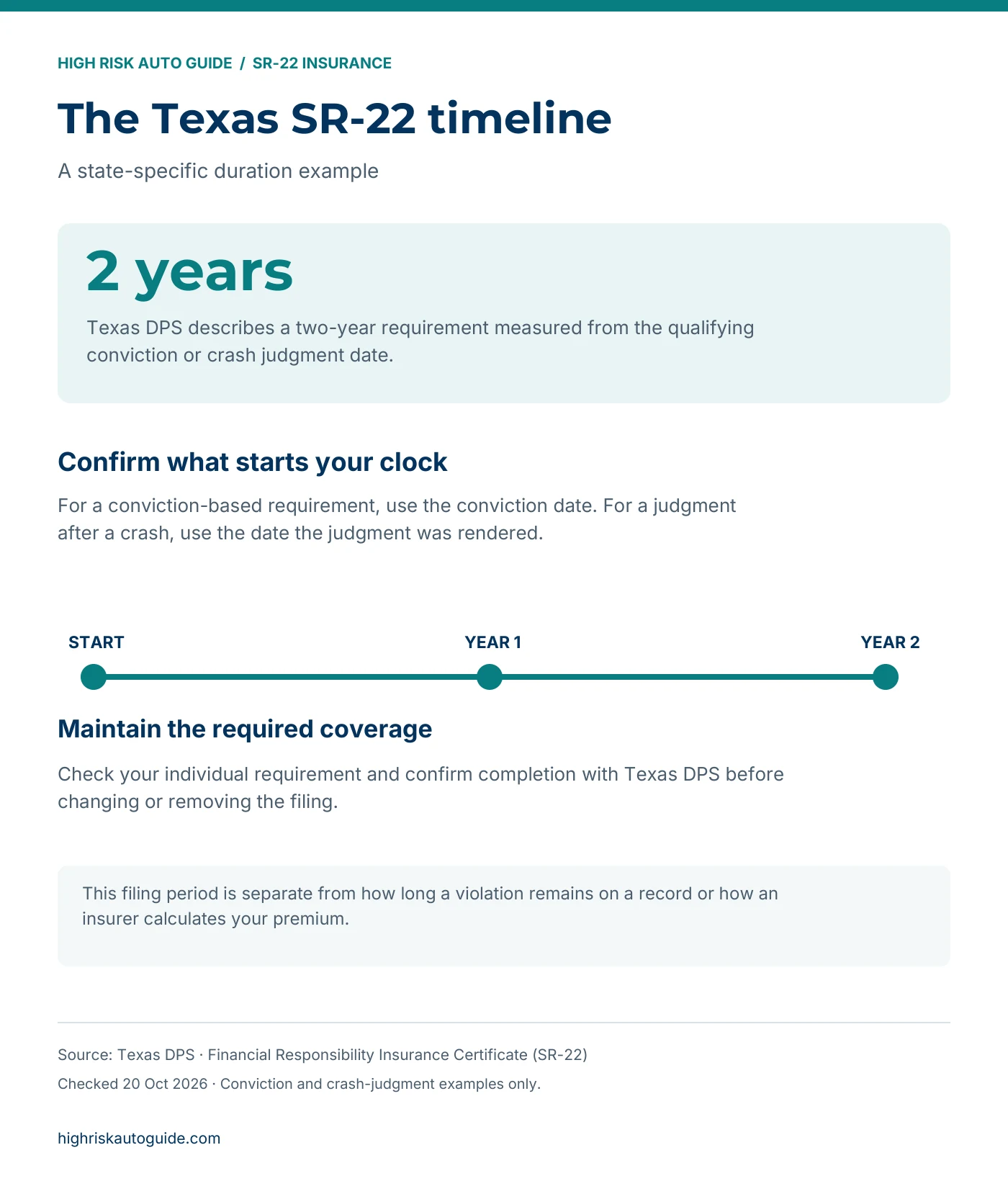
DPS sets the period at two years from the date of the conviction that requires the SR-22. In judgment cases, the clock runs from the date of the judgment. The FAQ adds three details that matter in practice.
- Filing late doesn’t reset the clock. If you file one year after the conviction, you keep the certificate for one more year.
- A new conviction extends the requirement.
- An insurance card doesn’t replace the certificate. Only the filed SR-22 counts.
For the same question across other states, see how long an SR22 stays on your record.
What SR22 Insurance Texas Costs in 2026
DPS publishes one charge tied to the certificate: a $100 reinstatement fee. Insurers add their own filing fee, which DPS doesn’t publish. Comparison sites quote $15 to $50 for it. The larger cost is the premium, and here the sources disagree sharply.
| Source | Date | Figure |
|---|---|---|
| ValuePenguin | Updated June 30, 2026 | About $88 a month for minimum coverage after a DUI, 72% above its $51 clean-record rate |
| MoneyGeek | Updated August 18, 2026 | $152 a month, or $1,824 a year, after a DWI |
| Insurify | Updated August 17, 2026 | $122 a month for liability only with an SR-22, $228 for full coverage, and $219 for a driver with a DWI conviction |
| The Zebra | Updated March 24, 2026 | $2,178 a year after a DUI, 54% above a $1,415 baseline |
The spread runs from about $88 to $219 a month. It reflects different profiles, coverage levels and quote data, not a real disagreement about Texas. Notably, Insurify puts the effect of the SR-22 itself at 11%. In other words, the conviction drives the price and the form adds little. So compare insurers on the total premium, and read how to lower your SR22 insurance premium before you sign.
How to Get SR22 Insurance Texas Style: Process, Timing and Non-Owner Cover
Start with your insurer. According to the DPS FAQ, not every company files SR-22 certificates, so ask before you pay a deposit. Once you have a policy, the insurer files the certificate with DPS. DPS says processing can take up to 21 business days, so allow for the wait when you plan a reinstatement.
If you own no vehicle, DPS points you to a Texas non-owner SR22 policy. It covers your liability when you drive vehicles you don’t own. It isn’t built for someone who has a car at home. We compare the trade-offs in non-owner SR22 insurance explained, and the full sequence is in how to get SR22 insurance.
Suspension Lengths and Fees After a DWI in Texas
The DWI side of the process carries its own numbers, and DL-176 lists them. A refusal to take a test brings a 180-day ALR suspension for a first offense and two years for a later one. A failed test (a result of 0.08 or higher) brings 90 days for a first offense and one year for a later one. DL-176 puts the ALR reinstatement fee at $125, against $100 for a DWI conviction suspension.
Drivers under 21 face a stricter track. DL-176 lists a one-year suspension for a first DWI under 21 and 18 months for a second. As a result, a young driver can reach the certificate requirement with a much longer suspension behind it.
| Situation | First offense | Later offense |
|---|---|---|
| Test refusal (administrative license revocation) | 180 days | Two years |
| Failed test, result of 0.08 or higher (administrative license revocation) | 90 days | One year |
| DWI under age 21 | One year | 18 months for a second |
| Reinstatement fee, administrative license revocation | $125 | $125 |
| Reinstatement fee, DWI conviction suspension | $100 | $100 |
Source: Texas DPS form DL-176.
Occupational License and SR22 Insurance Texas Drivers Ask About
Many drivers ask whether they can keep driving to work while suspended. Texas has an occupational license for that. According to the DPS FAQ on occupational licenses, the online fee is $10 for one year or $20 for two years, and an SR-22 is required for the application. An interlock restriction applies after an ALR suspension or a DWI.
That order of events is worth planning. Because the certificate is a condition of the occupational license, you can need a filed SR22 before you have a normal license back. Ask your insurer how quickly it files, and remember DPS says processing can take up to 21 business days.
What Happens If Your Texas SR22 Lapses
Your insurer must tell DPS when coverage cancels or lapses. If DPS receives no replacement filing, your driving privilege and vehicle registration may be suspended, according to the DPS SR-22 page. DL-176 lists a cancelled-insurance suspension as lasting until you resubmit proof, with a $100 reinstatement fee. The FAQ says a lapse can bring that $100 fee again.
Therefore, set up automatic payment on the policy and keep the renewal date in your calendar. Our guide to what happens when an SR22 lapses walks through the timeline.
SR-22A: A Term to Treat With Care
Some insurers and comparison sites mention an SR-22A, usually described as a six-month prepaid version. We didn’t find SR-22A on any DPS page we opened, and one comparison site says Texas uses only the SR-22. Ask your insurer which certificate DPS expects before you buy.
Fines for No Insurance and the Link to the SR22
The second no-insurance conviction is the point where SR22 insurance Texas rules apply. Under Transportation Code section 601.191, a first offense carries a fine of $175 to $350. Later offenses carry $350 to $1,000. If this is your situation, read car insurance after driving without insurance for the wider consequences.
What to Do Next
Do three things before you buy. Confirm with DPS which certificate your case needs. Ask at least three insurers whether they file in Texas. Then put the end date, two years from the conviction, in your calendar. The end date matters. Drop the certificate a month early and you face a suspension, and keep it a year late and you overpay.
Living elsewhere or planning a move? Compare SR22 insurance in California and SR22 insurance in Ohio, because durations and fees change by state.
The team at High Risk Auto Guide isn’t a licensed insurance agency. The information in this article is educational and based on official, verified sources as of the date noted. Confirm the details that apply to your specific case with your state’s DMV/BMV or with your own insurance company.