
Last updated: October 20, 2026
Does North Carolina require SR22? Not by that name. The NCDMV pages we reviewed talk about the DL-123, a liability insurance form your insurer completes. Insurify says the same thing: North Carolina doesn’t require an SR-22 and uses the DL-123 instead.
That difference sounds small. Still, it changes what you ask for at the counter and what you pay for. This article explains where the DL-123 shows up, how the 2025 limit increase and the lapse rules work, and what a DWI does to your license and your premium. Where sources disagree, we say so.
Does North Carolina Require SR22? What NCDMV Uses Instead
We read the NCDMV pages on October 12, 2026. None of them uses the term SR-22. The Proving Liability Insurance page lists the DL-123 among the documents it accepts, next to a policy, an insurance card, a binder and an insurer letter that follows the DL-123 wording. The company must hold a North Carolina license.
An NCDMV financial responsibility page adds the cases where proof applies. It names people getting an original license, including transfers from another state, people whose licenses are being restored after a revocation or suspension, and people the court awards a limited privilege license. In other words, the DL-123 follows you through licensing events. It isn’t a three-year sentence the way an SR-22 can be.
That page also says the DL-123, a binder or a certificate stays valid for 30 days from the issue date. So time the form to your appointment. A form issued three weeks early may expire before you reach the counter.
DL-123 vs FS-1: Two Forms, Two Jobs
In fact, drivers mix these up. The DL-123 supports a license transaction. The FS-1 is a Certificate of Insurance that your insurer sends electronically to NCDMV to clear a flagged lapse. NCDMV says that once it receives the FS-1, the fines are cleared.
For instance, suppose NCDMV flags a gap, but your insurer shows the policy never lapsed. The insurer files the FS-1, and the flag goes away. You don’t fill out a DL-123 for that. Ask your insurer which form matches your problem before you pay for either.
North Carolina Minimum Limits Changed in 2025
NCDMV lists two sets of minimums based on when your policy was issued or renewed. Policies issued or renewed after July 1, 2025 follow the higher set.
| Coverage | Before July 1, 2025 | After July 1, 2025 |
|---|---|---|
| Bodily injury, one person | $30,000 | $50,000 |
| Bodily injury, two or more people | $60,000 | $100,000 |
| Property damage | $25,000 | $50,000 |
In addition, coverage must include uninsured and underinsured motorist protection. A policy issued before July 1, 2025 can still show the old limits until it renews, so check your declarations page.
Lapse Penalties: Plate Revocation, Not License Suspension
North Carolina handles a lapse through your registration. Insurers must tell NCDMV when liability coverage is canceled or lapses for any reason. NCDMV then sends a notice to the vehicle owner.
The response window needs care, though. The NCDMV insurance requirements page says you have 10 days from the notice date, and that this becomes 30 days effective October 1, 2026. The statute text we read, G.S. 20-311, still says 10 days. Use the date on your notice, and answer it fast.
If you don’t respond, NCDMV can revoke the plate, and law enforcement may seize it. Civil penalties depend on prior lapses on the vehicle within three years: $50 with none, $100 with one and $150 with two or more. A $50 restoration fee applies at reinstatement. In addition, the statute says that a lapse with an accident, or knowing operation without coverage, brings a 30-day revocation. Otherwise the revocation lasts until you get coverage.
NCDMV also waives penalties and restoration fees if you register the vehicle in another state within 30 days and meet its return requirements. The statute adds a waiver for service members deployed outside the continental U.S. for 45 or more days when the notice was sent. For example, a driver who moves to Georgia and registers the car there within 30 days of the North Carolina policy ending avoids the penalty, as long as the paperwork is complete.
Restoring Your License After a DWI
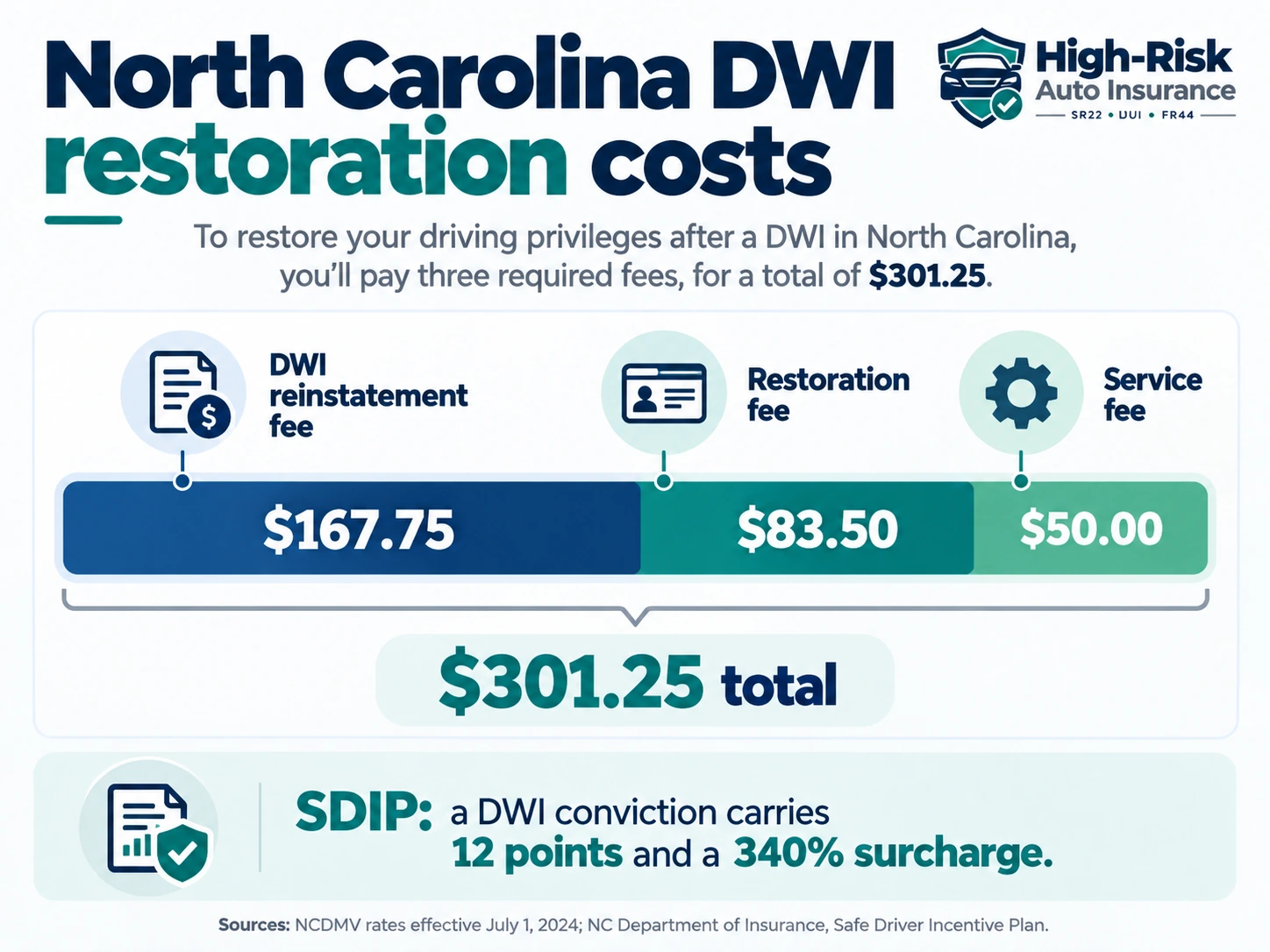
A DWI adds fees on top of everything else. So does North Carolina require SR22 after a DWI? Not by name, but you still need liability proof at restoration. The NCDMV restoration page lists the amounts effective July 1, 2024 to the present. The DWI reinstatement fee is $167.75, the restoration fee is $83.50 and the service fee is $50. Together they reach $301.25.
Still, some of those fees have exceptions. NCDMV doesn’t require the restoration fee when a medical evaluation led to the license being taken. It also drops the service fee if you surrendered the license to the court or mailed it to NCDMV before the suspension date. Check whether either applies to you, and otherwise budget for the full amount.
Specifically, an NCDMV financial responsibility page names restoration after revocation or suspension as a case for the DL-123. Get the form from your insurer before you visit, and keep it inside the 30-day window.
The DWI Surcharge: What 340% Really Means
North Carolina prices violations through the Safe Driver Incentive Plan, or SDIP. The NC Department of Insurance table assigns a DWI conviction 12 points and a 340% surcharge. Reckless driving carries 4 points and 90%. Driving during a revocation or suspension carries 8 points and 200%.
The surcharge applies to a rate increase, not to a flat dollar amount. As a hypothetical, a base premium of $1,000 would climb by $3,400, to $4,400. However, your actual figure depends on the insurer’s base rate. For convictions on or after July 1, 2025 with four or more points, the surcharge runs five policy years (speeding over the limit is excluded). Before that date, it ran three.
In practice, a single DWI conviction outweighs almost every other lever you have on price. Shop after the conviction posts, and again once the surcharge period ends. For more on DUI pricing across states, see how much insurance goes up after a DUI.
When Insurers Say No: The North Carolina Reinsurance Facility
North Carolina has an involuntary market called the North Carolina Reinsurance Facility. It’s a nonprofit pool the General Assembly set up in 1973. Insurers can cede eligible auto liability risks to it, and the insurer still issues and services your policy. January 2024 testimony to the legislature describes it that way.
The testimony describes insurers ceding risks, not drivers applying. That said, the mechanics vary by company, so ask your agent how your policy would be placed. If one company declines you outright, ask a different agent. Our guide to the assigned risk pool covers how these programs compare nationwide.
What DL-123 Drivers Pay in North Carolina
Plan for a range of $79 to $130 a month. Insurify, on a page updated September 30, 2026, gives $79 for liability-only and $130 for full coverage for drivers who need the DL-123. Clean-record drivers on the same page see $69 and $113.
Keep in mind that these are averages from one comparison site. In fact, the same page says no standard period exists for how long you maintain the form, so we can’t tell you a cost over time. NCDMV pages we read don’t state a filing period either. Confirm yours with the court or NCDMV.
Does North Carolina Require SR22 for You? A Short Checklist
Start with your paperwork. First, read your NCDMV notice and note whether it asks for a DL-123, an FS-1 or a policy copy. Second, ask your insurer for the right form with an issue date close to your appointment. Third, bring documents on paper and a digital copy, because NCDMV pages disagree on whether it accepts digital proof. Fourth, answer lapse notices early, since the response window is changing.
Finally, if a DWI is involved, call your insurer before the restoration visit. The cheapest mistake is arriving with an expired DL-123. For official wording, see the NCDMV vehicle insurance requirements and the NC Department of Insurance Safe Driver Incentive Plan pages.
The team at High Risk Auto Guide isn’t a licensed insurance agency. The information in this article is educational and based on official, verified sources as of the date noted. Confirm the details that apply to your specific case with your state’s DMV/BMV or with your own insurance company.